

Corporate travel is no longer a back-office function. In 2026, it is one of the most visible line items on a company’s operating budget, especially for multinational corporations, and one of the most consequential in terms of employee productivity, talent retention, and operational risk.
The Global Business Travel Association (GBTA) forecasts global business travel spending to reach $1.69 trillion in 2026, an 8.1% year-over-year increase that underscores the sector’s resilience amid economic uncertainty and regulatory shifts.That is a new nominal record, and it means that every business managing employee travel is doing so against a backdrop of rising costs, tightening budgets, and growing expectations from the people they send on the road.
More than eight in ten companies are increasing or stabilising their travel spend, but according to FCM Consulting, those budgets are not stretching the way they used to. Airfares are down three to five per cent globally as airlines adjust pricing, yet hotel rates remain volatile due to dynamic pricing and capacity constraints in key cities.The businesses that win in this environment are not the ones with the largest travel budgets. They are the ones with the best systems: the right corporate travel booking process, the right partner, and the right policy to keep spend under control without disrupting the travel that drives revenue.
This guide covers everything for finance directors, operations managers, HR leads, and executive assistants need to know about corporate travel booking in 2026: what it involves, how to choose the right platform or partner, how to build a policy that employees actually follow, how to manage costs and duty of care, and why local expertise matters, especially for companies operating in Ghana and across Africa.
What Is Corporate Travel Booking and Why It Matters for Your Business
Corporate travel booking is the end-to-end process through which businesses plan, authorise, book, manage, and report on employee travel. It covers flights, accommodation, ground transport, and ancillary services such as visa processing, airport protocol, and expatriate logistics. At its most basic, it is how your people get where they need to go. At its most strategic, it is a managed programme that drives cost efficiency, protects employee safety, and keeps the organisation compliant with its own policies.
The distinction between corporate travel booking and personal travel booking is not trivial. Four structural differences define why corporate travel booking requires its own systems and disciplines:
Approval workflows. Corporate travel bookings must be authorised against policy before being confirmed. A personal traveller books when they choose to book. An employee on a business trip booking should only confirm travel after the appropriate approval has been granted, and that approval should happen within the booking process, not after the ticket is issued.
Cost accountability. Every business trip booking must be tracked, cost-coded, and reconciled against a budget. Personal travel has no such obligation. Corporate travel does, and without a system to enforce it, spending becomes invisible and uncontrollable.
Duty of care. The company is legally and ethically responsible for employee safety during work travel. This obligation extends well beyond the flight. It includes pre-trip risk briefings, traveller location tracking, emergency support, and, for travel to higher-risk markets, formal evacuation arrangements.
Volume and frequency. Corporate travel is recurring. It involves dozens, hundreds, or thousands of trips across a year. At that scale, the difference between managed and unmanaged business travel booking is not just an operational inconvenience; it is a material financial gap.
Policy compliance is the single largest controllable cost lever in any corporate travel programme, according to travel management specialists with experience building platforms across multiple corporate client bases.Companies that treat booking as an administrative task rather than a managed programme consistently pay more, expose their people to greater risk, and have no visibility into either problem until the damage is done.

The Corporate Travel Booking Ecosystem: Platforms, Partners, and Policies
Understanding how corporate travel booking works in practice requires mapping the landscape of tools, stakeholders, and structures that businesses use to manage it. There are three principal delivery models, and the right one depends on the nature of your travel programme.
The Three Delivery Models
Model 1: Self-managed via online booking tool (OBT) or corporate travel software
The company deploys a corporate booking platform such as SAP Concur, TravelPerk, Navan, or Spotnana through which employees search and book travel directly. Policy guardrails are built into the tool: employees can only see options that fall within the company’s approved parameters. Expense reporting is typically integrated, closing the loop between booking and reconciliation.
This model works best for mid-to-large enterprises with high domestic travel volumes, predictable routes, and in-house travel management resources. Its limitation is significant: corporate travel software handles transactions efficiently but cannot manage complexity. Visa applications, airport protocol, expatriate logistics, emergency response, and on-the-ground support in unfamiliar markets are all beyond what a booking platform can deliver.
Model 2: Fully outsourced to a Travel Management Company (TMC)
The business partners with a specialist corporate travel management company that handles all bookings, policy design, on-ground support, and reporting. This is a human-led model; the TMC brings expertise, relationships, and accountability that a software platform cannot replicate.
This model suits companies that prioritise service quality over self-service efficiency, operate in markets where local expertise is essential (Africa, the Middle East, Asia), and want a single accountable partner rather than a technology subscription. A TMC also accesses negotiated corporate fares unavailable to individual bookers or small-volume platforms.
Model 3: Hybrid (corporate travel software + TMC)
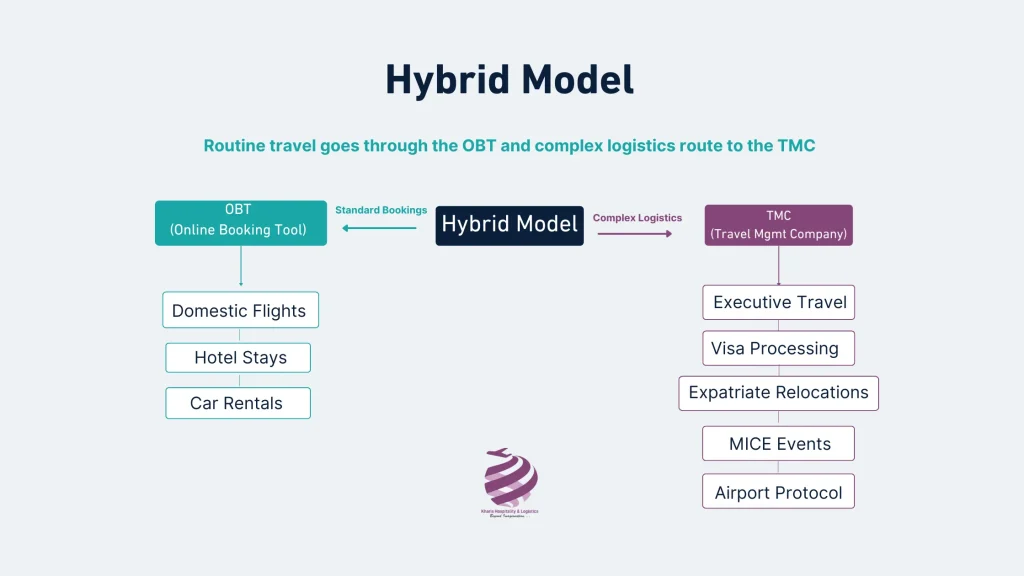
The most effective model for most growing businesses: corporate travel software handles routine, predictable bookings, domestic flights, and standard hotel stays, while a specialist TMC manages the complex, high-value, and high-risk elements: executive travel, international visa processing, expatriate relocations, MICE events, and airport protocol.
For businesses operating in Ghana or managing travel across West Africa, the hybrid model is almost always the operationally correct choice. Standard booking platforms are optimised for transatlantic and intra-European routes. Local complexity: Accra International Airport logistics, Ghana Immigration Service permit processing, and Accra’s corporate accommodation market require local expertise that no software platform provides.
The Components of a Corporate Booking Ecosystem
| Component | What it does | Who provides it |
|---|---|---|
| Online Booking Tool (OBT) | Employee self-service booking within policy. | Corporate travel software (SAP Concur, Navan, TravelPerk). |
| Travel Management Company (TMC) | Expert-managed travel, complex logistics, ground support. | Specialist TMC (Kharis Hospitality & Logistics). |
| Travel Policy Management System | Rules framework governing what can and cannot be booked. | TMC or OBT with policy configuration. |
| Expense Management Integration | Connection between booking and reconciliation. | ERP/expense platform (Concur, Zoho Expense). |
| Duty-of-Care & Traveller Tracking | Real-time itinerary visibility and emergency contact. | TMC or dedicated risk platform. |
| Visa & Permit Management | Immigration documentation for international travel. | TMC. |
| Airport Protocol | On-ground assistance at ports of entry and exit. | TMC with local presence. |
How to Choose the Right Corporate Travel Booking Solution: Platform vs. Partner vs. Both
For a finance director or operations manager evaluating business travel solutions, the range of options can obscure rather than clarify the decision. The following framework moves from self-assessment to solution selection in the correct order.
Step 1: Characterise Your Travel Profile
Before evaluating any corporate booking platform or TMC, define your travel programme across five dimensions:
- Volume: How many trips does your organisation make per month? Under ten trips per month, a managed TMC relationship typically delivers better value than an OBT subscription. Over fifty trips per month, technology integration becomes increasingly important.
- Complexity: Is your travel primarily domestic and point-to-point, or does it involve international routes, multi-destination itineraries, visa requirements, and group travel? Complexity is where platforms fail, and TMCs earn their fee.
- Route frequency: Do you repeatedly book the same corridors, Accra to London, Accra to Lagos, Accra to Nairobi? High-frequency routes create volume leverage for negotiated fares.
- Traveller seniority: Executive and VIP travel requires a different service level, airport protocol, upgraded accommodation, and dedicated support than junior staff travel. Both can coexist in a managed programme; they cannot both be served by a self-service OBT alone.
- Geographic focus: Does your travel concentrate in markets where local expertise and relationships are essential, such as Ghana, West Africa, and the Middle East? Or in well-trodden Western routes where global platforms are optimised?
Step 2: Define Your Requirements
Using your travel profile, build a prioritised requirements list:
- Must-haves: Human emergency support | visa and permit processing | policy enforcement at point of booking | consolidated spend reporting | local ground support at key destinations
- Nice-to-haves: Mobile booking capability | AI-powered trip suggestions | carbon emissions reporting | loyalty programme integration
Step 3: Evaluate Options Against Profile
| Requirement | OBT Only | TMC Only | Hybrid |
|---|---|---|---|
| Routine domestic bookings | ✔ | ✔ | ✔ |
| Negotiated corporate fares | Limited | ✔ | ✔ |
| International visa processing | ❌ | ✔ | ✔ (via TMC) |
| Airport protocol and VIP services | ❌ | ✔ | ✔ (via TMC) |
| Emergency human support | Limited | ✔ | ✔ (via TMC) |
| Policy enforcement at booking | ✔ | ✔ | ✔ |
| Expense reporting integration | ✔ | Varies | ✔ |
| Expatriate relocation logistics | ❌ | ✔ | ✔ (via TMC) |
| MICE and group travel management | ❌ | ✔ | ✔ (via TMC) |
| Consolidated spend analytics | ✔ | ✔ | ✔ |
Step 4: The Questions to Ask Any Corporate Travel Partner
When evaluating a TMC or corporate travel management partner, these are the questions that separate capable partners from credible-sounding ones:
- What is your support model, and who specifically answers the phone when a flight is cancelled in Lagos?
- Do you have established relationships with hotels, airlines, and ground operators in our key markets, and can you prove it?
- How do you handle visa rejection or immigration complications mid-trip?
- What does your duty-of-care framework look like in practice, not on paper?
- Can you provide references from companies with a travel profile similar to ours, same size, same destinations, same complexity?
The most common mistake businesses make in evaluating business travel solutions is prioritising platform features over service capability. Technology makes bookings convenient. Expertise protects your people and your budget.
Travel Policy Management: How to Build a Corporate Travel Policy That Employees Follow
Every company that manages employee travel needs a corporate travel policy. Most have one. Far fewer have one that works, because the policy sits in a shared drive that employees encounter for the first time when submitting expense claims, long after the money has been spent.
An effective travel policy is enforced at the point of booking, not at the point of reimbursement. It is built into the booking process, whether through a configured OBT or a pre-trip approval workflow managed by your TMC, so that non-compliant bookings are caught before money leaves the company, not after.
Why Most Corporate Travel Policies Fail
- They are written once and never updated. A policy drafted in 2021 does not reflect 2026 airfares, accommodation costs, or new external levies such as Ghana’s Airport Infrastructure Development Charge.
- They are too complex to follow at the moment of booking. Employees face a twenty-page document when all they need is a clear set of rules.
- They are inconsistently enforced; some employees are held to the letter, while others book freely and face no consequence.
- They are disconnected from the booking process, encountered only when an expense is queried, which is too late
The Five Essential Components of an Effective Corporate Travel Policy
1. Booking channels and lead times
Specify which channels employees are authorised to use: the company’s corporate booking platform, the TMC, or both. Set minimum lead times: a recommended minimum of 72 hours for domestic travel and five business days for international bookings. Lead times are not bureaucratic friction; they are the mechanism through which advance booking discipline is enforced, and advance bookings are consistently 20–40% cheaper than last-minute equivalents.
Define what constitutes an approved exception to lead times and who in the organisation can authorise it. Without this definition, “emergency” becomes a reason for any last-minute booking.
2. Flight class entitlements
Define by journey duration and employee seniority:
| Journey Duration | Standard Entitlement | Exception |
|---|---|---|
| Under 4 hours | Economy | — |
| 4–8 hours | Premium Economy | Director level and above: Business |
| Over 8 hours | Business Class | — |
Note that a TMC with consolidated volume can often access negotiated Business Class fares on key routes at rates closer to premium economy, making the premium smaller in practice than it appears in isolation.
3. Accommodation standards and spend caps
Set per-night spend limits by destination, not a single global figure that is too high for some markets and too low for others. Define approved hotel corridors (e.g., Airport Residential Area, Cantonments, Labone) and rate bands. Distinguish between short-stay hotel bookings and long-stay serviced apartment arrangements for extended assignments; the latter typically represent better value beyond two weeks and should be specified in policy.
4. Ground transport and airport transfers
Define approved ground transport providers and explicitly prohibit informal or unlicensed options. For companies operating in Ghana, pre-approved airport transfer arrangements through the company’s TMC should be the standard, not ad hoc taxi arrangements made on arrival. Specify whether ride-hailing platforms are permitted and, if so, under what conditions and cost limits.
5. Expense reporting and approval
Establish per diem allowances by destination, receipt requirements, submission timelines (recommended: within five business days of return), and cost code allocation for finance reconciliation. Integrate with your expense management system where possible, and ensure your TMC provides consolidated invoicing that maps directly to your cost code structure.
Corporate Travel Cost Management: How to Control Business Travel Spend in 2026
Travel budgets are not stretching the way they used to. More than eight in ten companies are increasing or stabilising corporate travel spend, but per-trip costs continue to rise, airfares are moving moderately, hotel rates remain volatile in key markets, and ancillary costs are growing.
In this environment, cost management is not optional. It is the difference between a travel programme that serves the business and one that quietly erodes margin.
There are five levers of corporate travel cost management, and most businesses are only pulling two of them.
Lever 1: Consolidation
The single greatest source of savings in corporate travel is consolidating all bookings through a single channel. When employees book independently through personal credit cards, consumer travel sites, or different corporate platforms, every booking is an island. Spend is invisible, volume is fragmented, and there is nothing to negotiate against.
Consolidating all business travel bookings through a single TMC or corporate booking platform generates the volume that unlocks negotiated airline and hotel rates. Those rates are unavailable to individual bookers. They are available, often substantially, to a TMC managing consolidated volume across a client portfolio.
Lever 2: Advance Booking Discipline
Policy compliance is the single largest controllable cost lever in any corporate travel programme.The most direct expression of that compliance is advance booking. Travel booked 14 or more days in advance consistently yields 20–40% savings compared with equivalent last-minute bookings. This is not just a travel industry claim; it is arithmetic that falls out of airline dynamic pricing models.
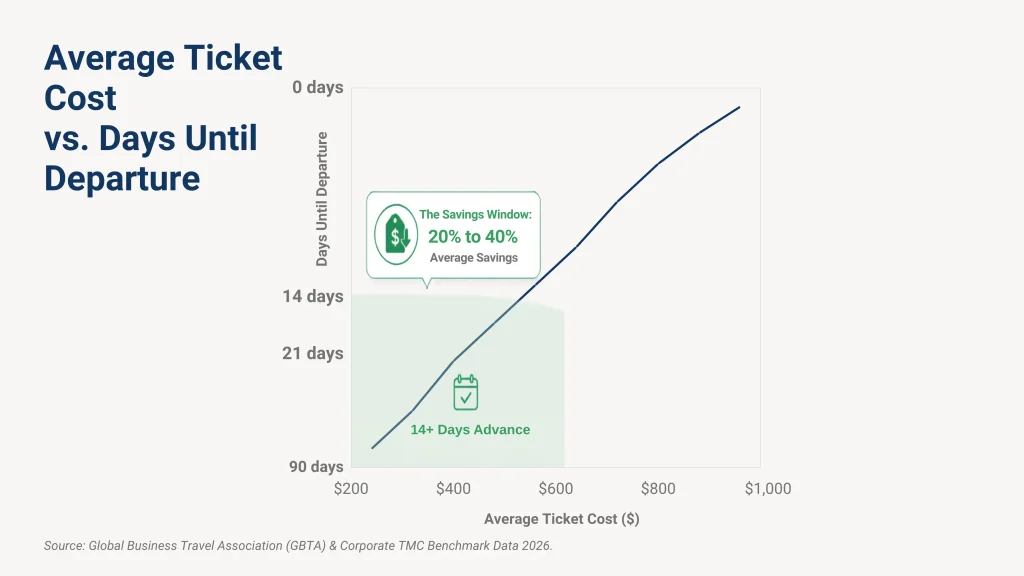
The mechanism is a minimum lead time in the travel policy, enforced at the point of booking. An OBT can flag or block last-minute bookings. A TMC can manage the pre-trip approval workflow that prevents them. Either way, the enforcement must happen before the booking is confirmed.
Lever 3: Preferred Supplier Programmes
Negotiate preferred rates with hotel properties and airlines on the routes your organisation travels most frequently. A TMC manages preferred supplier relationships across its entire client base, which means even a company with modest individual travel volume benefits from the aggregate negotiating leverage of the TMC’s portfolio.
Review and renegotiate preferred supplier agreements, as rate environments change. A preferred agreement struck in 2024 may no longer represent optimal value in 2026.
Lever 4: Eliminating Hidden Travel Costs
The most controllable and most overlooked costs in corporate travel are the ones that accumulate invisibly:
- Last-minute hotel upgrades taken outside policy and expensed anyway
- Out-of-network ground transport and taxi spend when pre-approved transfers are not arranged
- Excess baggage charges on routes where carry-on would be sufficient with better packing guidance
- Visa processing rush fees caused by applications initiated too close to departure are costs that are entirely preventable with a policy-mandated lead time for visa applications
- New external cost factors in 2026: Ghana’s Airport Infrastructure Development Charge (US$100 per international departure, effective April 2026) must now be modelled into per-trip cost budgets. For a company with ten international departures per month from Accra, this is US$12,000 in annual AIDC exposure, a known, forecastable cost that should appear in the travel budget, not in a year-end variance analysis
Lever 5: Reporting and Analytics
The most effective travel programmes in 2026 focus on routes where flight supply is increasing and costs are easing, as well as unlocking savings through smarter deals across all services. That focus is only possible with visibility, and visibility only comes from consolidated reporting.
A TMC or corporate travel software should provide monthly spend reports broken down by traveller, department, route, and supplier. These reports serve two purposes: they identify the specific behaviours and routes where costs are highest and policy compliance is lowest.
Without consolidated reporting, travel cost management is guesswork.
Duty of Care in Corporate Travel: What Every Business Must Get Right in 2026
According to the SAP Concur Global Business Travel Survey, 94% of business travelers stated that business travel is helpful (39%) or essential (55%) to success in their roles. These are people who depend on travel to do their jobs. The organisation that sends them on the road has a legal and ethical obligation to protect them while they are there.
Duty of care in employee travel management is not a tick-box exercise. It is the operational framework through which a company demonstrates and can prove, if required, that it took all reasonable steps to protect employee safety during business travel. In many jurisdictions, failure to meet duty-of-care obligations creates legal liability.
The Four Pillars of Corporate Travel Duty of Care
1. Pre-trip risk assessment
Before any employee departs on a business trip, the organisation should provide destination-specific risk briefings covering: health risks and vaccination requirements, the local security environment, relevant laws (particularly those affecting foreign nationals), emergency contact numbers, and the nearest embassy or consulate. For travel to markets with elevated risk profiles, these briefings should be formal, documented, and acknowledged by the traveller.
2. Traveller tracking
At any moment, the company should be able to identify where every travelling employee is based on the approved itinerary. This means knowing when they landed, where they are staying, and when they are scheduled to depart. A TMC provides itinerary tracking as a standard element of the service. Corporate travel software platforms with tracking modules provide an alternative for self-managed programmes. What is not acceptable from either a duty-of-care or a risk management perspective is no system at all.
3. 24/7 emergency support
Emergencies in business travel happen at unpredictable times. A flight cancellation that strands a team in Lagos on a Saturday. A natural disaster that requires immediate itinerary rerouting. The organisation’s travel management partner must be reachable to coordinate response, not via an automated chatbot, but via a human being with the authority and relationships to act.
An online booking platform without human support cannot fulfil this obligation. It is one of the most important distinctions between a corporate travel software subscription and a genuine corporate travel management partnership.
4. Medical evacuation and crisis management
For companies managing travel to or assignment in markets where local healthcare is limited or variable, medical evacuation insurance is a standard duty-of-care provision. This should be arranged in advance, confirmed with the traveller before departure, and the emergency contact details carried at all times. Companies managing expatriate populations in Ghana or other emerging markets should have formal medevac arrangements in place as a baseline, not as a response to an incident.
Duty-of-care encompassing personalized traveller support, safety alerts, and risk management is now a baseline expectation, not a differentiating feature, in corporate travel management.
Corporate Travel Booking in Ghana and Africa: Why Local Expertise Changes Everything
For businesses operating in Ghana or managing travel across Africa, the standard advice to choose an OBT, set a spend cap, and integrate with a corporate travel booking platform misses most of what actually matters.
Ghana’s corporate travel environment has specific characteristics that require specific expertise:
1. Immigration and visa complexity: Ghana’s immigration system encompasses business visas, work permits, resident permits, GIPC investor visas, and dependent permits for expatriate families. These are not categories that a standard corporate booking platform manages; they require a team with direct working relationships with the Ghana Immigration Service, knowledge of current processing timelines, and the ability to navigate complications when they arise. A missed work permit initiation deadline does not just cause inconvenience; it can delay an employee’s legal right to work in Ghana for months.
2. Accra International Airport logistics: The airport operates in ways that benefit significantly from on-ground expertise. VIP terminal logistics, immigration lane navigation, porter coordination, ground transport timing, and lounge access all work differently for travellers who have a professional greeter in the arrivals hall versus those managing their own way through. For executive travellers, delegations, and expatriates arriving in Ghana for the first time, the difference is immediate and material.

3. Accra’s accommodation market. The corporate accommodation market in Accra is active but opaque. The best serviced apartments in Airport Residential, Cantonments, and Labone are not listed on global platforms. They are let through local agent networks that only a locally embedded TMC can access. Companies relying on standard global platforms for Accra accommodation consistently pay more and get less.
4. The AIDC cost factor: Ghana’s Airport Infrastructure Development Charge, US$100 per international departure, effective April 2026, is a new line item that every company managing business travel bookings in and out of Ghana must now account for. It is a known, fixed cost that belongs in the corporate travel budget, modelled per trip and aggregated annually.
5. Regional African complexity: Many companies using Accra as a regional hub manage travel across multiple African markets, Nigeria, Côte d’Ivoire, Senegal, Kenya, and South Africa, each with different entry requirements, different ground transport dynamics, and different safety profiles. Managing employee travel across West Africa requires a TMC with genuine pan-African expertise and relationships, not a global platform optimised for European and North American routes.
For Ghana-based and Africa-focused businesses, aligning mobility strategy with local reality is the essential starting point.
What a Full-Service Corporate Travel Booking Partner Delivers in 2026
There is a practical difference between a booking tool and a travel management company, and it is most visible not when things go according to plan, but when they do not.
A corporate travel booking platform processes transactions. A corporate travel management company manages outcomes. When a flight is cancelled, a visa is rejected two days before departure, or a hotel fails to meet the standard expected of an executive client, the question is not which platform was used to make the booking. The question is who picks up the phone, who has the relationships to resolve the situation, and who is accountable for making it right.
This is what a full-service business travel solutions partner delivers, and what no booking software can substitute for.
What Kharis Hospitality & Logistics provides across the corporate travel booking lifecycle:
- Flight ticketing and negotiated corporate fares on key international routes from Accra, including Accra–London, Accra–Amsterdam, Accra–Dubai, Accra–Johannesburg, and Accra–New York — with consolidated invoicing and cost-code allocation for your finance team.
- VIP airport protocol at Accra International Airport with dedicated greeters, immigration assistance, porter services, executive lounge access, and coordinated ground transfers, making every arrival and departure seamless for your executive travellers and international delegations.
- Visa and work permit processing: end-to-end management of Ghana visa applications, work permits, residence permits, dependent permits, and GIPC investor visas, with active tracking and pre-emptive renewal management.
- Corporate accommodation management: curated portfolio of vetted hotels and serviced apartments across Accra’s prime business corridors, with preferred corporate rates and centralised booking management.
- Executive chauffeur and ground transport: managed fleet with professional drivers across Accra, with pre-arranged airport transfers and full-day or half-day hire for meetings and site visits
- Expatriate relocation programmes: comprehensive settling-in support for international professionals relocating to Ghana, from pre-arrival briefings and visa initiation through housing search, school placement, and ongoing concierge support
- MICE and group travel logistics: end-to-end management of corporate conferences, board retreats, and incentive travel programmes, including group flights, hotel block bookings, and on-the-ground event coordination
- Travel policy consulting: design and implementation support for companies building or revising their Ghana corporate travel policy, including policy integration into booking workflows
- Human support: because business trip booking emergencies do not observe business hours.
Contact Kharis Hospitality & Logistics to discuss your corporate travel booking requirements and what a managed programme would look like for your organisation.
Corporate Travel Booking Frequently Asked Questions
What is the difference between a corporate booking platform and a travel management company? A corporate booking platform, also called an online booking tool or OBT, is software that enables employees to search and book travel within policy parameters. It handles transactions efficiently but cannot manage complexity: it does not process visa applications, provide on-ground airport support, handle emergency re-routing at midnight, or negotiate directly with hotels and airlines on your behalf. A travel management company is a human-led partner that provides all of these services and is accountable for outcomes, not just bookings. The two are not mutually exclusive; many effective corporate travel programmes use OBT software for routine bookings and a TMC for complex travel and emergency support.
How much can a business save through managed corporate travel booking? Savings depend on the starting point, but companies moving from unmanaged to managed business travel booking typically reduce total travel spend by consolidating supplier volume, enforcing advance booking discipline, and eliminating out-of-policy spend. The specific savings will vary by organisation, but the three primary levers- consolidation, advance booking, and preferred supplier rates— each deliver measurable benefit, and their effects compound when applied simultaneously. Your TMC should be able to model projected savings against your current travel profile before you commit to a programme.
What should a corporate travel policy include? At minimum: approved booking channels and lead times; flight class entitlements by journey duration and employee seniority; accommodation spend caps by destination; approved ground transport providers and airport transfer arrangements; visa and immigration compliance requirements including lead times for permit applications; expense reporting requirements and per diem allowances by destination; and the approval workflow for policy exceptions. The policy should be integrated into the booking process and enforced at the point of booking, not discovered in expense review.
How do I manage the duty of care for employees travelling on business? Duty of care in employee travel management requires four active elements: pre-trip destination risk briefings, real-time traveller tracking based on approved itineraries, emergency support access, and formal medical evacuation arrangements for travel to markets where local healthcare is variable. These are not optional for organisations taking their legal and ethical obligations seriously. A travel management company embeds all four into a managed travel programme as standard.
What is the best corporate travel booking approach for a small or medium business in Ghana? For SMEs operating in Ghana with regular international travel needs, a TMC relationship typically delivers better value than an OBT subscription. OBT platforms are optimised for high-volume, routine travel on well-established routes. Ghana-based SMEs face immediate complexity in visa and work permit requirements, Accra International Airport logistics, and access to Accra’s opaque corporate accommodation market that a booking platform cannot address. A local TMC such as Kharis provides the expertise, relationships, and service level that an SME cannot build in-house, at a cost that scales with travel volume.
How does corporate travel booking work for expatriate employees? Expatriate travel management adds significant complexity to standard booking workflows. In addition to flights and accommodation, it involves visa and work permit initiation, resident permit processing, dependent permits for family members, temporary accommodation while permanent housing is sourced, area orientation, school placement for children, and ongoing concierge support during the settling-in period. A full-service TMC manages all of these as a single coordinated programme, ensuring that the expatriate arrives in Ghana legally authorised to work and genuinely settled within the shortest possible timeframe.
What is travel policy compliance and why does it matter? Travel policy compliance refers to the percentage of corporate bookings made within the company’s approved policy parameters, correct booking channel, within spend caps, booked with sufficient lead time, via approved suppliers. It matters because out-of-policy bookings are consistently the most expensive in a travel programme: they tend to be last-minute, unplanned, and reconciled through time-consuming manual expense processes. Improving compliance is the fastest and most controllable route to reducing total travel spend, and it requires that the policy be enforced at the point of booking, not reviewed weeks later in expense reports.
How does Kharis Hospitality & Logistics manage corporate travel booking in Ghana? Kharis operates as a full-service travel management company for businesses in Ghana and internationally mobile organisations whose travel includes Ghana. We manage the complete corporate travel booking lifecycle: flight ticketing, airport protocol at KIA, visa and permit processing, corporate accommodation, executive ground transport, expatriate relocation, and MICE logistics under one coordinated managed account. Every client has a dedicated account manager, consolidated monthly reporting, and 24/7 on-call support.
Contact us to discuss what a managed travel programme would look like for your organisation.
Corporate Travel Booking in 2026: The Bottom Line
Corporate travel in 2026 is about strategic, purposeful connection in a hybrid world, and the businesses that manage it most effectively are the ones that travel with intention, protect their people with genuine duty of care, and control their costs through visibility and consolidation rather than restriction.
The framework is straightforward: assess your travel profile honestly → choose the right delivery model for your complexity and volume → build a travel policy that enforces itself at the point of booking → pull all five cost management levers, not just the obvious two → protect your people through genuine duty-of-care infrastructure → and choose a partner with the local expertise to deliver where it matters most.
For businesses operating in Ghana or managing travel across West Africa, the last point is not incidental; it is foundational. The complexity of Ghana’s immigration landscape, Accra International Airport’s operational environment, and Accra’s corporate accommodation market all require local knowledge that no global platform can substitute for.
Kharis Hospitality & Logistics is built for exactly this environment. One partner. Full coverage across the corporate travel booking lifecycle. Local expertise that translates directly into operational outcomes. And a commitment to getting your people where they need to be and home again safely.
Contact Kharis Hospitality & Logistics today to discuss your corporate travel programme.
Related Topics:
→ Corporate Travel Management in Ghana — the complete guide: Read now
→ Ghana Travel Visa Guide — every visa category explained: Read now
→ Expatriate Relocation Services in Ghana: Read now
→ How Ghana’s new AIDC levy affects your travel budget: Read now