
Relocating to Ghana is one of the most professionally rewarding decisions an international professional can make. Accra is dynamic, fast-growing, English-speaking, and increasingly sophisticated as a business hub, but settling into a new country, especially one you have never lived in, is a process that can overwhelm even the most experienced global traveller if left unmanaged.
The difference between an expatriate who hits the ground running and one who spends their first three months struggling with housing disputes, visa anxieties, and the challenge of finding a reliable doctor is rarely about personal resilience. It is almost always about the quality of the expatriate relocation support they received from day one.
This guide covers everything you need to know about relocating to Ghana as an expat, whether you are a multinational deploying international talent, an HR manager designing a relocation programme, or an individual professional preparing for an assignment in Accra. And it explains exactly how Kharis Hospitality & Logistics supports every stage of that journey.
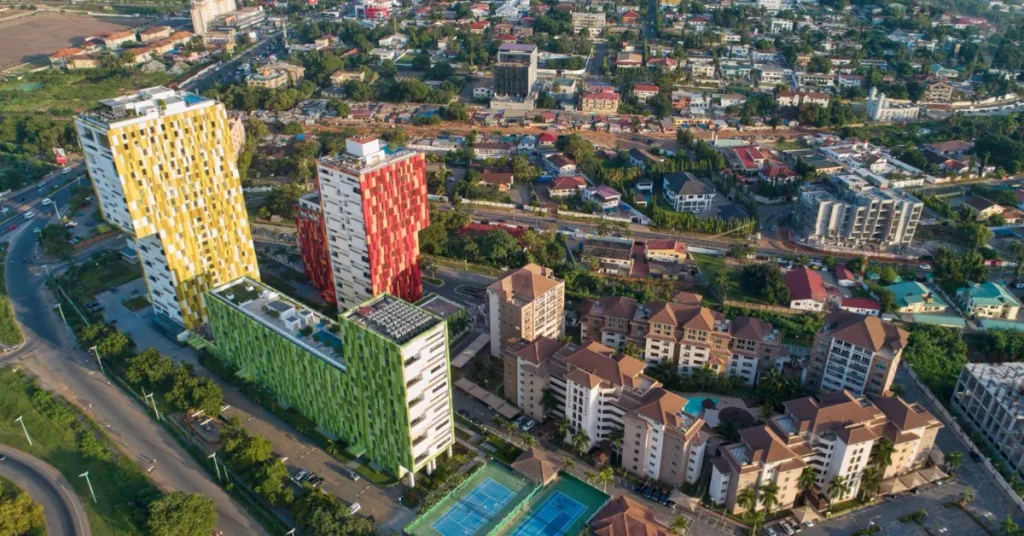
Why Ghana Is a Top Destination for Expatriate Professionals
Before unpacking the relocation process, it is worth understanding why Ghana has become one of Africa’s most attractive expatriate destinations, and why the volume of inbound international talent continues to grow year on year.
Ghana offers a combination of factors that few African countries can match simultaneously:
Political stability. Ghana has one of the continent’s longest records of peaceful democratic governance, with multiple successful elections and smooth transitions of power. For expatriates and their families, this matters enormously when choosing where to commit to a multi-year assignment.
English language. As a former British colony, Ghana’s official language is English. Business, education, government, and daily commerce are all conducted in English, significantly reducing the language barrier that complicates expatriate life in many other African markets.
A growing economy with regional reach. Accra functions as the regional headquarters for a growing number of multinationals, NGOs, and development finance institutions operating across West and Central Africa. Being based in Ghana provides access to a fourteen-country regional market.
Lifestyle quality. Accra offers a rich social and cultural life, restaurants spanning every cuisine, a vibrant arts scene, beautiful beaches within an hour of the city, and a warm, welcoming local culture that makes integration genuinely enjoyable.
For these reasons, sectors including oil and gas, mining, financial services, fintech, agribusiness, international development, and infrastructure continue to bring expatriate professionals — and their families — to Ghana in significant numbers.
The Challenges of Relocating to Ghana Without Support
Understanding why professional relocation support matters requires being honest about what moving to Ghana without it actually looks like.
Visa and immigration complexity. Ghana’s immigration system has multiple permit categories, business visas, work permits, resident permits, and GIPC investor visas, and the documentation requirements, processing timelines, and inter-agency coordination involved are not straightforward. Errors in applications cause delays that can prevent a professional from legally working in Ghana for weeks or months after their intended start date.
The housing market. Accra’s rental market for expatriate-grade accommodation is active and fast-moving, but it is not transparent. Listings are inconsistent, landlord quality varies widely, and many of the best properties are let through local agent networks that international property platforms do not reach. Without local connections, expatriates frequently end up in overpriced or underperforming accommodation.
School placement. For families with children, finding a school is often the most emotionally charged part of a relocation. Accra has many good international schools, but places are competitive, admissions timelines are strict, and a family that arrives without a confirmed school placement can face a disruptive wait.
The hidden complexity of daily life. Understanding which neighbourhoods are most suitable for expatriate living, where to access quality healthcare, how utilities are managed, and what a reasonable cost of living looks like, these are questions that cannot be answered through a Google search and that matter enormously to settlement success.
Professional expatriate relocation services in Ghana exist to eliminate these friction points, so that the professional is contributing productively from day one, and the family is settled, comfortable, and supported.
Kharis Expatriate Relocation Services:
At Kharis Hospitality & Logistics, we provide end-to-end expatriate relocation services designed for international professionals, multinational corporations, and any organisation bringing talent into Ghana. Our programme is structured in four phases that mirror the natural arc of a relocation.
Phase 1: Pre-Arrival Preparation
A well-managed relocation begins well before the expatriate sets foot on a plane.
Visa and Work Permit Initiation: We initiate the immigration process as early as possible, ideally several days before the planned arrival date. Our team manages documentation collection, application preparation, submission to the Ghana Immigration Service, and ongoing status liaison. We handle work and residence permits, resident permits, and dependent permits for accompanying family members, so the entire household arrives with its paperwork in order.
Accommodation Arrangement: Unless the expatriate’s permanent housing is already confirmed before arrival, we arrange quality accommodation in a serviced apartment in a prime business neighbourhood. This provides a comfortable, well-located base from which a long-term housing search is conducted.
Phase 2: Arrival
The first days in Ghana set the tone for the entire assignment.
VIP Airport Meet-and-Greet Our team meets every relocating expatriate at Accra International Airport (formerly Kotoka International Airport) with a personal greeting, luggage porter services, and a direct transfer to their temporary accommodation. Arriving in a new country to find a professional, friendly face waiting for you makes an immediate and lasting impression.
Practical Set-Up Assistance In the early days, a new arrival faces a stream of practical tasks that individually seem small but collectively consume enormous energy: obtaining a local SIM card or opening a bank account. Our team handles or facilitates each of these so that the expatriate’s energy is directed where it matters.
Living in Accra as an Expatriate: What to Expect
1. Neighbourhoods
Airport Residential Area is the most popular base for international professionals and is the closest premium residential area to the airport, making it highly convenient for frequent travellers. It is home to numerous embassies, corporate offices, and international schools.
Cantonments is an upscale, leafy neighbourhood popular with senior executives and diplomats. Properties tend to be spacious and well-maintained, and the area has a distinctly residential, quiet character.
Labone offers a slightly more local flavour while still providing strong amenity access, a growing restaurant scene, and good connectivity to Accra’s main business districts.
East Legon is further from the city centre and airport but offers some of Accra’s most spacious and value-competitive housing, popular with families who prioritise space and a quieter environment.
2. Healthcare
Accra’s private healthcare sector includes several high-quality hospitals and clinics — among them Trust Hospital, Nyaho Medical Centre, and Korle-Bu Teaching Hospital for specialist referrals. Medical evacuation insurance is recommended for all expatriates, particularly for conditions requiring specialist care not available locally.
3. Cost of Living
Accra is not an inexpensive city for expatriate-standard living. Rental costs for a quality three-bedroom apartment in a prime neighbourhood, international school fees, and imported food and lifestyle costs combine to make Accra more expensive than many expatriates initially anticipate. A realistic budget, planned in advance, prevents financial strain during the assignment.
4. Getting Around
Most expatriates in Accra rely on private vehicles or managed chauffeur services for daily movement. Public transport exists but is not routinely used by the expatriate community. Accra’s traffic can be severe at peak hours; knowing the key routes and avoiding certain corridors at certain times is local knowledge that our drivers and concierge team readily share.
For HR and Mobility Managers: Designing an Expatriate Programme for Ghana
If you are an HR or global mobility professional responsible for deploying international talent to Ghana, the structure of your relocation programme directly impacts assignment success, time-to-productivity, and your organisation’s ability to attract and retain the best people.
Our corporate relocation service includes: a dedicated account manager for your HR team, standardised onboarding documentation, real-time status updates throughout each relocation, post-arrival feedback collection, and permit renewals.
Frequently Asked Questions
How long does an expatriate relocation to Ghana typically take? The overall timeline depends primarily on visa and work & residence permit processing, the longest single variable. With early initiation, most professionals can be settled into permanent accommodation within two to four weeks of their decision to relocate. We recommend beginning the process weeks before the intended start date.
Do accompanying family members need their own visas or permits? Yes. Spouses and dependent children require their own dependent permits, which are typically processed alongside the primary work and residence permit application. We manage the full household’s immigration paperwork as a single coordinated process.
Can Kharis help if I am already in Ghana but did not initially use a relocation service? Absolutely. We regularly work with expatriates who are already in Ghana and need help with housing, immigration regularisation, or ongoing expat support. Get in touch, and we will assess your current situation and design a support package from wherever you are in the journey.
What is the typical cost of expatriate accommodation in Accra? Rental costs vary significantly by neighbourhood, property type, and size. A quality two-bedroom apartment in Airport Residential or Cantonments typically commands a higher premium than equivalent areas in other major African cities. We advise all clients on current market rates during the pre-arrival briefing and negotiate on their behalf to ensure fair value.
Is it safe to live in Accra as an expatriate? Ghana is widely regarded as one of Africa’s safest countries for expatriate professionals and families. Accra is a generally low-threat environment by international standards, and the expatriate community lives, works, and socialises actively. Standard personal security awareness applies, and we brief all incoming clients on practical security guidelines as part of our pre-arrival orientation.
Begin Your Ghana Relocation
Whether you are an individual professional preparing for an assignment or a corporate mobility team managing a programme, Kharis Hospitality & Logistics is the partner that makes relocating to Ghana straightforward, well-managed, and genuinely welcoming.
Our team is based in Accra, deeply embedded in the local market, and entirely committed to one outcome: that every expatriate we support arrives in Ghana ready to make the most of one of Africa’s most exciting professional environments.
Contact Kharis Hospitality & Logistics to discuss your relocation requirements with a specialist. We will respond within one business day.
→ Read more: Corporate Travel Management in Ghana: The Complete Guide